
Preparation of heterocyclic compounds:
Five membered heterocyclic compounds like pyrrole, furan and thiophene are synthesized conveniently from 1,4-dicarbonyl compounds by following methods.
- Paal-Knorr synthesis: This is a cyclization reaction where 1,4-dicarbonyl compound gets cyclized upon heating in presence of ammonium carbonate resulting in the formation of pyrrole.
- If 1,4-dicarbonyl compound is heating in presence of phosphorous pentoxide (P2O5), then the resulting compound is furan.
- 1,4-dicarbonyl compound gives thiophene upon heating in presence of phosphorous trisulfide (P2S3).

Apart from the preparation method mentioned above, pyrrole, furan and thiophene are also synthesized from other methods also as mentioned below.
Synthesis of pyrrole:
-
- Distillation of succinimide gives pyrrole. This distillation process is carried over zinc dust.

2. Knorr-Pyrrole synthesis: This is a condensation reaction in which α-amino ketone is condensed with β-diketone or β-ketoester for obtaining a substituted pyrrole.

3. Catalytic heating of furan, ammonia and steam form pyrrole. The catalyst used in this reaction is alumina.

4. Passing a mixture of acetylene and ammonia over a red-hot tube result in the formation of pyrrole.

Synthesis of furan:
-
- Furan can be synthesized from pentoses (carbohydrates). This is a two-step reaction in which the first step is distillation process in which the pentose is distilled with dilute sulfuric acid to form 2-formylfuran (Furfural) followed by catalytic decomposition in which the formed 2-formylfuran is decomposed in steam in presence of a catalyst like calcium hydroxide resulting in the formation of furan.

2. One more twostep reaction is from mucic acid. The first step is dry distillation of mucic acid, which results in the formation of furoic acid which will undergo decarboxylation in presence of copper and quinoline to form furan.

Synthesis of thiophene:
Thiophene is prepared either by heating butane and sulfur at 600°C/sodium succinate and sulfur in presence of phosphorous trisulfide or by passing a mixture of acetylene gas and hydrogen sulfide over heated alumina at 400°C.


Synthesis of pyridine:
1. A mixture of acetylene and hydrogen cyanide form pyridine when passed through a red-hot tube.

2. Pyridine is also synthesized from pentane-1,5-diamine dihydrochloride salt. This salt, upon heating, forms piperidine which on dehydrogenation or reduction with Pd/C results pyridine.

3. Β-carbonyl compound, upon condensation with aldehyde and ammonia gives a dihydropyridine derivative. This dihydropyridine derivative, in presence of mucic acid, gets oxidized to give pyridine derivative. This method of synthesis is called as Hantzsch Snthesis.

Synthesis of pyrazole:
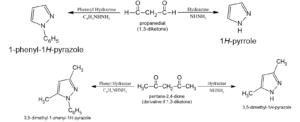
1. Pyrazole can be synthesized from 1,3-dicarbonyl compounds. The reaction of these 1,3-dicarbonyl compounds with hydrazines or hydroxylamines gives pyrazole.
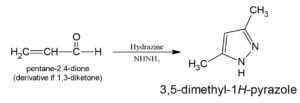
2. Reaction of propargyl aldehyde with hydrazine gives pyrazole.
Synthesis of imidazole:
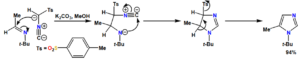
1. Imidazole can be synthesized from isocyanides.
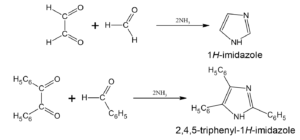
2. Imidazoles can also be prepared from dicarbonyl compounds by condensation in presence of ammonia with aldehyde.
Synthesis of oxazole:
1. Van Leusen Oxazole Synthesis:
Aldehydes upon reacting with tosylmethyl isocyanide (TosMIC) form oxazole.

2. Oxazole is synthesized from ethyl-α-hydroxyketo succinate which forms diethyloxazole-4,5-dicarboxylate by reacting with formamide. The formed product gives oxazole upon hydrolysis and subsequent decarboxylation.

3. Robinson-Gabriel synthesis: This method is cyclization reaction in which α-aminoketone undergoes cyclization and subsequent dehydration to give 2,5-diaryloxazoles.
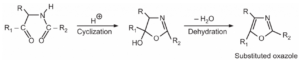
4. Fischer oxazole synthesis: Hermann Emil Fischer in 1896, discovered that cyanohydrin and aldehyde react with each other in presence of anhydrous HCl to form oxazole.

Synthesis of thiazole:
1. Unsubstituted thiazole is formed from reaction of chloralhydrate with thioformamide.

2. Gabriel synthesis: α-acylamino ketones react with phosphorous pentasulfide and form 2- or 5- or 2, 5-disubstituted thiazoles.
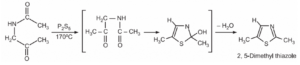
3. Cook-Heilborn’s synthesis: α-aminonitriles when treated with dithioacids or esters or other suitable reagents like carbon disulfide, carbon oxysulfide or isothiocyanates under mild conditions, yield 5-aminothiazoles.

Synthesis of quinoline:
-
- Skraup synthesis:
This reaction begins with formation of acrolein from dehydration of glycerol by concentrated sulfuric acid. Aniline is added to this acrolein and heated with a mild oxidizing agent to produce quinoline.

2. Friedlander synthesis:
This is the condensation reaction in which o-aminoacetophenone or o-amino benzaldehyde condenses with aldehyde or ketone with an active α-methylene group in alcoholic sodium hydroxide solution to yield quinoline.

3. Pfitzinger synthesis:
Substituted quinoline is synthesized from isatin.

4. From indole:
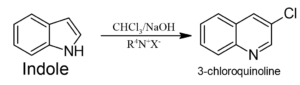
Indole and chloroform react together in presence of tetra-alkyl ammonium salts to form chloroquinoline.
Synthesis of isoquinoline:
1. Pomeranz-Fritsch synthesis:
In this reaction, aryl aldehyde is condensed to arylaldimine which on treatment with strong acids, undergoes cyclization reaction giving rise to isoquinoline. This is a twostep reaction in which the first step is condensation and the second step is cyclization.

2. Pictet-Spengler synthesis:
This is the reaction between aryl ethane amine and aldehyde. This reaction results in the formation of an imine, which under mild acidic conditions to form 1,2,3,4-tetrahydroisoquinoline. This cyclization reaction can also occur in physiological conditions and in nature also, this cyclization is an important reaction for the formation of tetrahydroisoquinoline alkaloids. The formed tetrahydroisoquinoline further by dehydrogenation with palladium yields isoquinoline.

3. Bischler-Napieralski synthesis:
Treatment of 2-phenylethylamine with formylchloride gives N-formyl-2-phenylethylamine which converts into 3,4-dihydroisoquinoline upon heating with phosphorous pentoxide. This 3,4-dihydroisoquinoline forms isoquinoline upon oxidation with palladium or selenium.

Synthesis of acridine:
1. Ullmann synthesis:
This reaction involves condensation and dehydrogenation reactions. In condensation reaction, aromatic primary amines are condensed with aromatic aldehydes or aromatic carboxylic acids in presence of strong mineral acids like H2SO4/HCl. Then dehydrogenation reaction is followed.

2. Bernthsen synthesis:
This reaction occurs in presence of zinc chloride between diphenylamine and carboxylic acid which is condensation and results in the formation of acridine.

3. Friendlander synthesis:
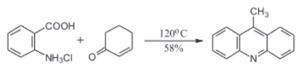
This is the reaction between the salt of anthranilic caid and cyclohex-2-enone at 120°C to yield acridine.
4. Condensation of diphenylamine:
Diphenylamine is condensed with chloroform along with alkyl chloride to yield acridine

Indole synthesis:
1. Fischer indole synthesis:
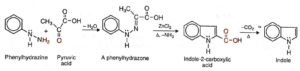
This reaction is the treatment of pyruvic acid with phenylhydrazine which results in corresponding phenylhydrazone which on heating produces indole-2-carboxylic acid from which indole is formed by decarboxylation.
2. Reissert synthesis:
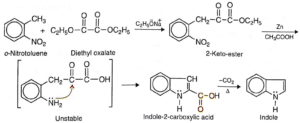
o-nitrotoluene form a 2-ketoester upon condensation with diethyl oxalate. Indole-2-carboxylic acid is formed from this ketoester by reducing it with zic and glacial acetic acid. The formed indole-2-carboxylic acid upon decarboxylation, yields indole.
3. Lip synthesis:
In this method, indole is synthesized from o-amino-ω-chlorostyrene by heating at 160-170°C with sodium ethoxide.

4. From o-toluidine:
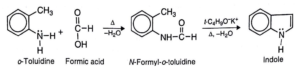
o-toluidine in this method is treated with formic acid to form N-formyl-o-toluidine which yield indole by dehydration upon heating with potassium t-butoxide.
5. From o-nitrophenylacetaldehyde:
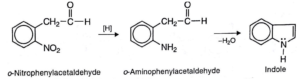
o-nitrophenylacetaldehyde upon reduction with iron powder and sodium bisulphite, yields o-aminophenylacetaldehyde. This product yields indole by spontaneous cyclization.
Synthesis of pyrimidine:
1. Biosynthetic pathway:
De novo pathway is followed by majority of organisms to synthesize pyrimidine. This synthetic pathway starts with bicarbonate and ammonia, often derived from glutamine and in this pathway, there are six enzymes involved namely, carbamoyl-phosphatase synthetase, aspartate carbamoyltransferase, dihydroorotase, dihydroorotase dehydrogenase, orotate phosphoribosyltransferase and orotidine-5’-phosphate decarboxylase.

2. From acetyl acetone:
This synthetic method was proposed by Lewis et al. They synthesized pyrimidine derivatives from acetyl acetone.

3. From α-methyl or α-methylene ketones:
This is a palladium catalyzed synthesis of pyrimidines by the reaction of α-methyl or α-methylene ketones with formamide and was developed by Lejon et al.

Synthesis of purine:
1. Purine was first synthesized by German chemist Emil Fischer in 1884.
2. Traube synthesis:
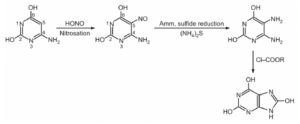
This reaction involves nitrosation of 4-amino-2,4-dihydroxy pyrimidine at 5th position. This is followed by reduction reaction. Reduction occurs at 5th position. Nitroso group is reduced to amino group using ammonium sulfide which is followed by ring closure with formic acid or chloro carbonic ester to form substituted purine.
3. Caffeine synthesis:
Caffeine is synthesized from uric acid.

Synthesis of azepines:
1. From benzene:
N-ethoxycarbonyl-1H-azepine is produced from benzene on treating with ethoxy carbonyl nitrene. The formed azepine on heating with alkali followed by isomerization, yields 3H-azepine. This reaction can be considered as an example for valence bond isomerism.

2. From nitrobenzene:
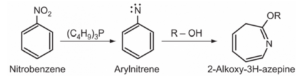
The nitrobenzene with tributylphosphine is deoxygenated and forms arylnitrene which undergoes ring expansion through intramolecular rearrangement in the presence of primary/secondary alcohol to yield 2-alkoxy-3H-azepines.
3. From phenylazide:
In presence of primary and secondary amines, phenylazide undergo decomposition to yield 3H-azepine derivatives.
