
Reactions of Pyrrole, Furan, Thiophene and their derivatives:
- All the three compounds pyrrole, furan and thiophene are electron rich in nature and participate in electrophilic substitution reactions like nitration, sulfonation, acetylation, halogenation, mercuration, formylation. These compounds will also react with organometallic compounds like Grignard reagents and also with diazonium salts.
Nitration:


Sulfonation:

Acetylation:

Halogenation:

Mercuration:
Furan and thiophene form corresponding 2-mercury chloride derivatives by reacting with mercury (II) chloride in presence of sodium acetate. For pyrrole, mercuration reaction is very difficult reaction.

Formylation:
In this reaction, dimethylformamide (DMF) in presence of phosphorous oxychloride (POCl3) is used as formylating agent and the reaction is carried out using Vilsmeier-Haack reaction.

With organometallic compounds:
Pyrrole reacts with Grignard reagent and form pyrrol-2-magnesium bromide whereas furan and thiophene, because of their less reactivity, react with more electropositive metals like butyllithium resulting in the formation of corresponding 2-lithium derivatives.

With diazonium salts:
Pyrrole gives azo compounds and bis-azo compounds whereas furan gives 2-aryl derivatives with diazonium salts.

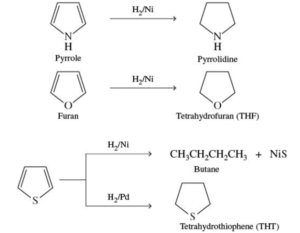
2. Apart from these reactions, these compounds will also undergo reduction reactions.
Pyrrole and furan give tetrahydro derivatives with H2/Ni. Thiophene undergoes ring opening reaction with H2/Ni whereas, gives tetrahydro derivative with H2/Pd.
Reactions and uses of pyridine and its derivatives
- Electrophilic substitution reactions:
Pyridine undergo electrophilic substitution at 3rd position or at meta position.

- Nucleophilic substitution reactions:
Pyridine, as is a deactivated aromatic ring system, 2nd and 4th positions of pyridine are electron deficient in nature. Hence, 2nd and 4th positions are favored for nucleophilic substitution reactions.

With sodamide, pyridine forms 2-aminopyridine and the reaction is called as Chichibabin reaction.

Pyridine also reacts with metallic compounds resulting in the formation of 2-alkyl or 2-aryl compounds.

With potassium hydroxide, pyridine forms 2-pyridone.

- Oxidation reactions:
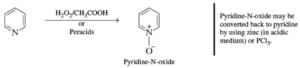
Oxidation occurs in presence of hydrogen peroxide or peroxy benzoic acid and the resulting product is pyridine-N-oxide.
- Reduction reactions:
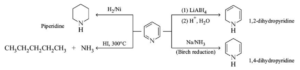
In presence of different reducing agents, pyridine behaves differently and forms different products. The reduction reactions of pyridine are summarized as follows.
Reactions and uses of pyrazole and its derivatives:
Pyrazole is electron rich in nature. Hence, it participates in electrophilic substitution reactions. Apart from electrophilic substitution reactions, this compound also participates in reaction at free nitrogen, oxidation and reduction reactions also.
- Electrophilic substitution reactions:
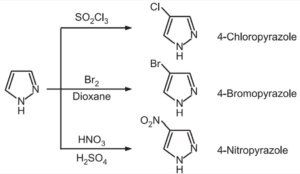
In pyrazole, electron rich sites are position 1, 2, 4. Hence, electrophilic substitution occurs on these three positions and among these positions also, readily on position 4.
- Reactions on free nitrogen:
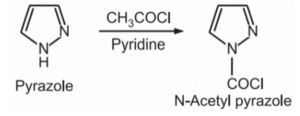
In presence of acetyl chloride and a weak base such as pyridine, acylation is readily done on free nitrogen.
- Oxidation:
Pyrazole ring is highly stable to oxidation reactions. But the side chains if present any, and the free nitrogen undergoes oxidation.

- Reduction:
Pyrazole derivatives undergo reduction reactions under various reaction conditions.

Reactions of imidazole:
- Electrophilic substitution:
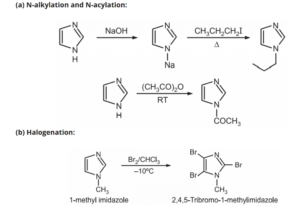
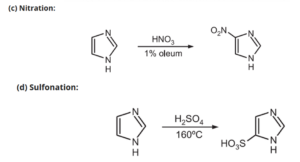
In imidazole, 1st, 3rd, 4th, 5th positions are electron rich and at these positions, electrophilic substitution reactions take place.
- Nucleophilic substitution:
The only position available for nucleophilic substitution is 2nd position.

- Action of oxidizing agents:
Imidazole won’t undergo auto-oxidation as it is stable to it and also to the action of chromic acid. However, hydrogen peroxide and perbenzoic acid attack imidazole.

- Reaction with acids:
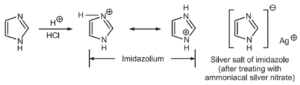
Imidazole with strong acids, undergo protonation at N3-position forming stable crystalline salts.
Reactions of oxazole:
- Electrophilic substitution reactions:
In oxazole, 4th and 5th positions are favorable for electrophilic substitution reactions and among these both positions also, 4th position is more favorable.

- Nucleophilic substitution reactions:
2nd position is favorable for nucleophilic substitution reactions.

- N-alkylation:
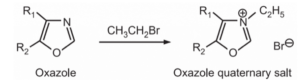
Reaction with alkylating agents give quaternary salts or N-alkyldiazonium salts.
Reactions of thiazole:
- Electrophilic substitution reactions:
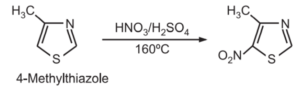
4th and 5th positions are favorable for electrophilic substitution reactions.

- Nucleophilic substitution reactions:
2nd position is favorable for nucleophilic substitution reactions.

Reactions of quinoline:
- Electrophilic substitution reactions:
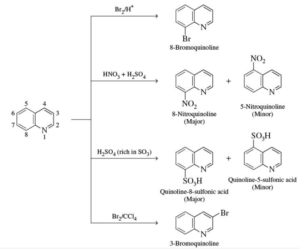
Quinoline undergoes electrophilic substitution reactions and favored positions are 5th and 8th positions. Electrophilic substitution reactions occur on benzene ring of quinoline as nitrogen hetero atom acts as deactivating group and hence, comparatively, benzene ring is having more electron density. Because of this reason, quinoline is more reactive towards electrophilic substitution reactions than pyridine.
- Nucleophilic substitution reactions:
Nucleophilic attack occur on pyridine ring as this ring is electron deficient because of nitrogen. The favorable positions are 2nd and 4th positions.

- Oxidation reactions:
Quinoline gives pyridine-2,3-dicarboxylic acid in presence of potassium permanganate.

- Reduction reactions:
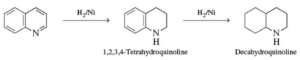
Catalytic reduction of quinoline forms 1, 2, 3, 4-tetrahydroquinoline in presence of nickel which upon further reduction gives decahydroquinoline.
Reactions of isoquinoline:
Isoquinoline behaves similar to quinoline in its chemical reactions. Isoquinoline participates in electrophilic substitution reactions at 5th and 8th positions and nucleophilic substitution reactions at 1st position.

Reactions of acridine:
Acridine undergoes electrophilic substitution reactions, nucleophilic substitution reactions, reduction reactions, oxidation reactions, reductive and photoalkylation reactions.
- Electrophilic substitution:
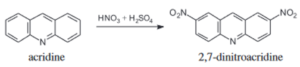
Acridine gives electrophilic disubstituted product. This disubstitution occurs at 2nd and 7th position.
- Nucleophilic substitution:
Nucleophilic reactions show different regiochemistry with different reagents. With NaNH2 acridine forms 9-aminoacridine in presence of liquid ammonia whereas in N,N-dimethylaniline, acridine forms 9,9’-bicrydanil.

- Reduction reactions:
Reduction reactions are also different with different reagents inn acridine. With Zn/HCl, acridine forms pyridine ring resulting in the formation of 9,10-dihhydroacridine whereas, reduction with Pt/HCl reduces benzene rings of acridine forming octahydroacridine.

- Oxidation:
Oxidation occurs in acidic and basic medium forming different compounds. In acetic acid, oxidation with dichromate gives acridone whereas in basic medium, with permanganate gives quinoline-2,3-dicarboxylic acid.

- Alkylation:
Alkylation reactions in acridine are of two types. Reductive and photoalkylation.
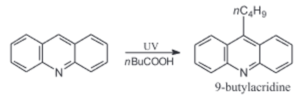
Reductive alkylation results in the formation of 9-butylacridine by reacting with n-pentanoic acid in presence of ultraviolet light.
Photoalkylation forms 10-methyl-9,10-dihydroacridin-9-ylmethanol in presence of UV light from N-methylacridine hydrochloride and methanol.

Reactions of indole:
Indole undergoes electrophilic substitution reactions.
Substitution at position-2:

Substitution at position-3:

From the above resonance structures, we can easily identify that the favorable position for electrophilic substitution reactions is position-3.
- Nitration:
Nitration occurs in presence of ethylnitrate at low temperature.

- Sulphonation:
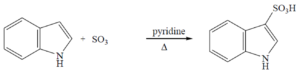
Sulphonation occurs only at milder conditions and to minimize the acidity of the reagent, pyridine-sulfur trioxide complex is used.
- Bromination:
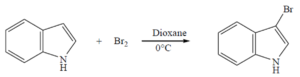
Bromination occurs at 3rd position at very low temperature (as low as 0°C) in dioxane.
- Friedelcraft’s alkylation:
Alkylation takes place in solvent like N,N-dimethyl formamide (DMF) or dimethylsulfoxide (DMSO) with alkyl iodide.

- Diazotization/Diazo coupling reactions:
With benzene diazonium salts, indole forms a diazotized coupled product 3-phenylazoindole.

- Reimer Tiemann formylation:
Two products are formed inn this reaction. The C3-formylated product and the rearranged product. By reacting with chloroform inn presence of alkali, indole, like other aromatic compounds forms formylated products at 3rd position and this happens via carbine intermediate.
