- Ozonolysis:
This is breakdown of ozone. Ozone reacts rapidly with alkenes in presence of organic solvents like carbon tetrachloride or light petroleum to form carbonyl compounds via formation of an intermediate called ozonide. In this reaction, ozone acts as an electrophile. This reaction occurs in two ways: reductive ozonolysis results in the formation of aldehydes and/or ketones and oxidative ozonolysis results in the formation of carboxylic acids and/or ketones.

Mechanism:
Step 1: Addition of ozone:
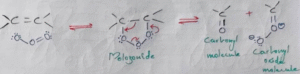
Electrophilic addition of ozone to alkene results in the formation of carbonyl and carbonyl oxide ions via an unstable intermediate called molozonide which because of its unstability, breaks down into the specified ions.
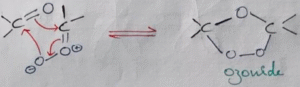
Step 2: Formation of ozonide:
The formed ions in the above step will rearrange themselves to form ozonide intermediate.
Step 3: Cleavage of Ozonide:
The ozonide, formed in the above step will decompose/break down to give respective carbonyl compounds.

-
- Markonikov’s Rule/Markonikov’s Orientation:
Observe the below reactions:

The above are the two possibilities for the formation of a halo alkane.
In the first reaction, the hydrogen atom of hydrogen halide is attached to the first carbon atom i.e., the carbon atom on which a greater number of hydrogens are present where as in the second reaction, the hydrogen atom is attached to the second carbon atom i.e., the carbon atom on which more alkyl groups are attached.
When a hydrogen halide is added to a asymmetric alkene, there is a possibility of the formation of 2-halo alkane or 1-halo alkane. To explain the possibility of the formation of the major product, a scientist named Markonikov proposed a rule. According to this rule, when a hydrogen halide is added to an asymmetric alkene, the acid hydrogen will get attached to the less substituted carbon atom i.e. the carbon atom which is having more hydrogen atoms. This rule is called as Markonikov’s rule.
Hydration of alkenes
Hydration of alkenes also occurs according to Markonikov’s rule.

- Anti-Markonikov’s Rule/Anti-Markonikov’s Orientation:
The vice-versa will be anti-Markonikov’s rule. when a hydrogen halide is added to an asymmetric alkene, the acid hydrogen will get attached to the more substituted carbon atom i.e., the carbon atom which is having more alkyl substituents.
- Free radical Addition reactions:
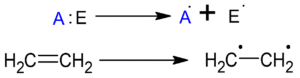
We know that addition reactions are the characteristic reactions of alkenes and alkynes. These addition reactions may occur through different mechanisms like ionic mechanism and free-radical mechanism. Free radical addition reactions occur when the reagent undergoes homolysis and form free radicals.

Mechanism of Free-radical addition reactions:
This occurs in presence of free-radical producing agent. The process occurs via homocyclic fission.
Step-1: Formation of free radicals
Step-2: Attack of the free radicals

Overall reaction:

- Rearrangement of Carbocations:
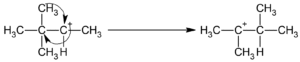
Rearrangement means arrangement in another manner. That means, the first arrangement is destroyed and again will be arranged in such a way that the molecule will be more stable. Any molecule or ion will rearrange itself or reposition itself to attain more stable state. Likewise, carbocations also will move from an unstable form/state to a more stable form/state. This movement occurs through various structural recognitional shifts within the molecule. Carbocation will undergo mainly two such kind of shifts to attain more stability.
Hydride shift:
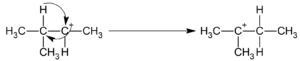
Hydride shift means movement of hydrogen from one carbon to its neighbor carbon. This is seen oftenly with the reaction of alcohol with hydrogen halides.
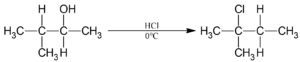
Step 1: Protonation:

Step 2: Dehydration:

Step 3: Rearrangement or hydride shift:
Alkyl shift:
This means movement of alkyl group from one carbon atom to its neighbor carbon atom.
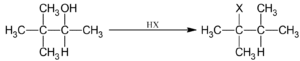
Step 1: Protonation:

Step 2: Formation of carbocation or Dehydration:

Step 3: Rearrangement or alkyl shift: