The open chain hydrocarbons are named as the aliphatic hydrocarbons. In these aliphatic hydrocarbons, if one or more hydrogens are replaced or substituted with halogens, then those are called as aliphatic halogen compounds. Halogen compounds can be defined as the compounds that contain halogens as their functional group.
Classification and nomenclature:
- Depending upon the number of other carbon atoms attached directly to the carbon atom to which the halogen is attached, the compound is called as primary, secondary or tertiary compound.
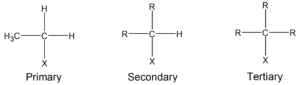
- The halogen compounds are also called as halides. As these aliphatic halogen compounds are the alkyl derivatives, these can also be called as alkyl halides.
- These alkyl halides like the alkyl compounds, can be given two kinds of names.
- Common names for simpler halides

Note: Similar name doesn’t always mean the same classification.
Eg: Isopropyl chloride – secondary chloride
Isobutyl chloride – primary chloride
- IUPAC names in which the compound is simply named as an alkane with a halogen as a side chain.

General methods of preparation:
- Halogenation of certain hydrocarbons:
Halogenation is nothing but the addition of halogens. Here in this process, to synthesize alkyl halides, the aliphatic hydrocarbons are halogenated. i.e. halogens are added to the aliphatic hydrocarbons.


- Addition of hydrogen halides to alkenes and alkynes:
In this method of preparation, hydrogen halides (H-X) are added to alkenes and alkynes. Here in this process, the unsaturated bond will move away from the atom on which the halogen attacks and the π-electrons will shift to the adjacent atom on which the halogen is attached. The hydrogen will attack the atom on which the π-electrons are present.


- Halide exchange:
This method of preparation is used to prepare the required halogen compounds. If we have any halogen compound, we need some other halogen derivative, then the available halogen compound is subjected to react with the halogen that is needed. In this case the halogens will get exchanged and the required halogen derivative will be obtained. Here the halogen presents in the compound we select should be less reactive than the halogen we need.

- From alcohols:
In this, the alcoholic hydroxyl (‘-OH’) will get substituted with halogen. The reason for this reaction is that the halogen is more reactive than the hydroxyl group and is capable of breaking the existing bond between carbon and hydroxyl group. As the halogen is more electronegative than the hydroxyl group, this carbon atom will get attracted towards halogen more than the hydroxyl group.

- From silver salts of carboxylic acids:
The silver salts of carboxylic acids react with halogen in presence of carbon tetrachloride, forming an unstable intermediate.

That intermediate will eventually undergo decarboxylation thermally to give alkyl halide.


This reaction of formation of alkyl halides from silver salts of carboxylic acids inn presence of carbon tetrachloride is called as Hundiecker reaction.
- Preparation of poly halides:
Poly halides means more than one halide. This occurs when halogen has been added to unsaturated hydrocarbons like alkenes and alkynes.
When halogens are added to alkenes, vicinal dihalides will be formed.

When halides are added to alkynes, tetrahalides will be formed.

- Preparation of vinyl halides:
Vinyl halides can be defined as the halogen compounds in which halogen atom is directly attached to one of the two carbon atoms that are sharing double bond.

Characteristic nucleophilic substitution reactions:
- When methyl bromide is treated with sodium hydroxide in a solvent that dissolves both reagents, the obtained products are methanol and sodium bromide.

- Here an alkyl halide is converted into an alcohol.
- We can observe that the ‘-OH’ group is substituted for ‘-BR’ in the original compound.
- Hence this can be said as a substitution reaction.
- This reaction is clearly heterolytic i.e. the departing or leaving halide ion takes the electron pair it has been sharing with carbon along with it.
- This reaction can also be treated as the nucleophilic substitution reaction as the attacking reagent is nucleophilic in nature.
- These nucleophilic substitutions are characteristic of alkyl halides.
- This can be explained by the weak basic character of the halide ion or by the strong acidic character of the hydrogen halide.
- The halide ion readily releases a proton or a positive charge to another bases.
- In alkyl halides, as the halogen is attached to carbon it readily releases carbon to other bases.
- These bases possess an unshared pair of electrons and are seeking relatively positive site to share their electron pair.
- Basic, electron-rich reagents that tend to attack the nucleus of carbon are called nucleophilic reagents or simply nucleophiles.
- If this attack results in substitution, then the reaction is “nucleophilic substitution”.

- Here the carbon compound is the substrate and is the spot, on which substitution takes place.
Attacking agent is nucleophile and the displaced group from carbon is the leaving group.
Factors that play role in SN1 and SN2:
Factors that affect substitution reaction are:
- Structure of the substrate (alkyl halide):
The structure of alkyl halide determines the type of substitution reaction undergone.
The steric hindrance and electron density around the α-carbon atom plays a major role in deciding the type of substitution reaction.
As the hindrance and the electron density around the α-carbon increases, the ionization tendency of alkyl halide also increases, whereas direct attack of nucleophile is repelled.
Thus, a primary alkyl halide predominantly undergoes SN2 type of substitution reaction and a tertiary alkyl halide undergoes SN1 type of substitution reaction.
A secondary alkyl halide exhibits similar reactivity towards both SN1 and SN2 reactions.
- Type of nucleophile:
A strong nucleophile (hydrogen ions or alkoxide ions) or high concentration of the nucleophile proceed with SN2 type of substitution reaction where as a weak nucleophile (water, alcohol) proceed with SN1 type of substitution reaction.
- Nature of the solvent used:
A low polar or a non-polar solvent favors SN2 type of substitution, where as a high polar solvent favors SN1 type of substitution reaction.
Walden inversion:
2-bromooctane and 2-octanol both are chiral i.e., they have molecules that are not superimposable on their mirror images.
Also, these can exist as enantiomers and con show optical activity.
Optically active 2-octanol has been obtained by resolution of the racemic modification and form optically active 2-bromooctane.

Here (-)-bromide and (-)-alcohol have similar configurations.
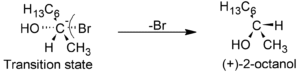
Now, when (-)-2-bromooctane is allowed to react with sodium hydroxide under suitable conditions, the obtained product will be (+)-2-octanol.

Here we see that the ‘–OH’ group has not taken the position previously occupied by ‘-Br’; the alcohol obtained has a configuration opposite to that of bromide.
A reaction that yields a product whose configuration is opposite to that of the reactant and is said to proceed with inversion of configuration and is known as Walden inversion.
Mechanism:
Step 1: Nucleophilic attack from the opposite side of the leaving group
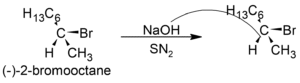
Step 2: Formation of a transition state

Step 3: Separation of the leaving group.