
Stereochemistry:
Stereochemistry is all about the three-dimensional study of the structural features of an organic molecule/substance. When we talk about structural features, mainly structural features include the arrangement of atoms or groups in an organic molecule. Hence, in stereochemistry, we will study about the arrangement of atoms or groups in a particular molecule or compound in a three-dimensional way. Hence, stereochemistry is defined as a branch of science that deals with three-dimensional study of organic molecules.
In stereochemistry, as we discuss about structural aspects of the organic molecules, an important structural feature of the organic molecules called isomerism has to be discussed in detail to understand the behaviour of the molecule precisely. The arrangement of the atoms or groups in a molecule is called as its configuration.
Stereoisomers:
Isomerism is that property of two molecules which are having the same molecular formula but different structural formula. When it is about isomers, we know that isomers are two different molecules and those both will be having the same molecular formula i.e., the same combination (number and type) of atoms but differs in different aspects like the connectivity, position, nature, functional group etc. But stereoisomers are that kind of isomers which differ from each other only in the way the atoms or groups are arranged in space. Also, stereoisomers are not two different organic molecules but are two different forms of the same organic molecule.
Different types of Stereoisomers:
Different types of stereoisomers are enantiomers, diastereomers and meso compounds. When we talk about stereoisomers, we should talk about two terms which distinguish the stereoisomers from each other. Those two terms are superimposability & chiral/stereogenic center. This nature superimposable means, aligning with another exactly and not showing any perceptible difference. That means, any organic molecule aligns on another organic molecule exactly and if we cannot observe any difference between both of them, then those two organic molecules are said to be superimposable to each other. In stereoisomerism, we will be mostly discussing about the superimposability of organic molecules with their mirror images. Chiral center or stereogenic center is the carbon atom that is directly attached to four different groups. One organic molecule may have one or more than one chiral center or stereogenic center.
- Enantiomers:
Enantiomers are non-superimposable mirror images. That means, if one organic molecule is the mirror image of another and both of them are not superimposable on each other, then those two molecules are called as enantiomers. Enantiomers differ in their configuration at stereogenic center i.e., they differ in their structure only in the left and right handness of their orientation. Enantiomers will be having similar physical and chemical properties except two important aspects.
- Rotation of the plane of polarized light: Different enantiomers rotate the plane of polarized light in different directions. The isomer or enantiomer that rotate the plane of polarized light towards left hand side or anti-clockwise, it is called as levo rotatory and is indicated by (-)-sign while the isomer or the enantiomer that rotate the plane of polarized light towards right hand side or clockwise, it is called as dextro rotatory and is indicated by (+)-sign. As the enantiomers differ in rotating the plane of polarized light, these are often also called as optical isomers.
- Enantiomers react at different rates in presence of other chiral compounds. These reaction rates may be so close that the distinction is practically not possible or they may be far different that one enantiomer reacts with high rate while the other won’t react at all.
We saw that enantiomers rotate the plane of polarized light either in the clockwise or anti-clockwise direction. This property of enantiomers to rotate the plane of polarized light is called as optical activity. Naturally, the organic compounds exist as a mixture of equal amount of both of their enantiomers. This mixture of equal amounts of both the enantiomers is called as racemic mixture. Tartaric acid was the first racemic mixture found by Louis Pasteur. He found that tartaric acid was the mixture of its two enantiomeric isomers.
Optical activity:
Optical activity is the property of any compound to rotate the plane of polarized light.
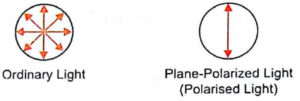
Enantiomers are optically active. Optical activity of any compound can be both detected and measured by using an instrument called polarimeter.
Construction of polarimeter:
Polarimeter consists of:
- A light source
- Two lenses: Polarizer or Nicole lenses
- A tube: For holding the substance whose optical activity is testing.
All of these are arranged systematically so that the light passes through one of those lenses (polarizer), then the tube (sample), second lense (analyzer) and finally reaches our eyes.

When both the lenses are arranged in same direction that they pass the light vibrating in the same plane and the tube is empty, then maximum amount of light reaches the eye of the observer. If we rotate the lense that is near the eye of the observer, then the amount of the light that reaches the eye will reduce and it will be minimum than the previous position. Now while fixing the equipment, the lense should be adjusted inn such a way that maximum amount of light reaches the observer’s eye. Now, if we place the sample in the tube and pass the light, if maximum amount of the light reaches the observer’s eye as before, we can say that the sample is optically inactive as it didn’t affect the plane of the polarized light. If the substance rotates the plane of polarized light, then minimum amount of the light only reaches the observer’s eye and the substance is said to be optically active. If the intensity of the light increases when the lense is rotated in clockwise direction, then the compound is dextro rotatory and if the intensity of light is increased when the lense is rotated anti-clockwise, then the substance is called as levo rotatory.

By using this polarimeter, we can not only find the direction of the plane of polarized light the substance rotated, but also how much amount. The amount of rotation is simply the number of degree that we must rotate the lense to get the maximum intensity. This number is called as specific rotation.

Specific rotation:
Specific rotation is defined as the amount of the angle of rotation in degrees of the plane of polarized light when it is passed through a tube of 1 decimetre length containing substance in solution at a concentration of 1 gram per millimeter in a polarimeter. Specific rotation is indicated by [α]D. This specific rotation is measured by using the formula
