
REACTIONS OF SYNTHETIC IMPORTANCE
Synthesis is the major application area of chemistry. The method of synthesis is used to produce one or more new compounds and, in this method, the chemical reactions are implemented artificially. Hence, synthesis can be defined as a method in which one or more compounds are obtained by artificial execution of chemical reactions. The synthetic process involves the use of one or more substances which are called as reactants and reagents which undergo transformation when exposed to specific conditions.
For creating the desired product, a variety of treatments may have to be used.
In this chapter, we will be discussing about a few reactions that are having synthetic importance in organic chemistry and their mechanisms.
- Metal hydride reduction:
Reduction is one of the most important and common synthetic methods used in organic chemistry. The literal meaning of reduction is making something smaller or lesser may be in amount, degree or size. In this reaction, the term refers to the degree or state of oxidation of the substance. The oxidation state of an atom or the molecule participating in the reaction will be reduced. However, it is also observed that carbon-carbon multiple bonds and also multiple bonds between carbon and other atoms are also reduced to lower or saturated bonds. Hence, all of these reactions are called as reduction reaction. There are a certain group of compounds in organic chemistry which cause reduction reactions. Such compounds are called as reducing agents. Metallic hydrides are one of such a group of compounds and cause reduction of the compounds.
In organic chemistry, the unsaturated hydrocarbons and unsaturated functional groups participate in reduction reactions most commonly. Among such compounds, aldehydes and ketones are the most commonly used compounds with unsaturated functional groups (carbonyl functional group). Metallic hydrides are used to reduce carbonyl compounds like aldehydes, ketones, carboxylic acids, acid halides, amides, esters and other compounds.
Various carbonyl compounds undergo reduction reactions by transfer of a hydride on to them from reducing agents. In metallic hydride reduction reactions, reagent or reducing agent like metallic hydride transfer a hydride to carbonyl compounds resulting in the formation of primary and secondary alcohols.
In this reaction, compounds like lithium aluminium hydride (LiAlH4), sodium borohydride (NaBH4) are used as the reagents or reducing agents. Typically, metallic hydrides do not reduce carbon-carbon double or triple bonds. However, lithium aluminium hydride (LiAlH4) is an exception which reduces carbon-carbon multiple bonds if present in conjugation with an aromatic system on one side and the carbonyl group on the other side.
Some examples:

Example for reduction of carbon-carbon multiple bond:

Mechanism:
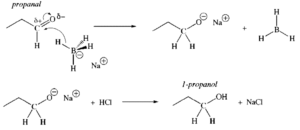
Step-1: Attack of nucleophile (attack of Hydride ion): Formation of alkoxide:

Step-2: Protonation of alkoxide:

Mechanism of reduction with NaBH4:
Note:
NaBH4 is a weak reducing agent and hence, cannot reduce less reactive carboxylic acids and esters. Hence, LiAlH4 is preferred to reduce these compounds, which is more reactive and can be used to reduce all types of carbonyl compounds.
Applications:
This reaction is mainly used to prepare primary and secondary alcohols.
- Clemmensen reduction:
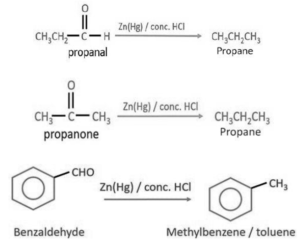
This is another type of reduction reaction method. In this reduction reaction, a different product is formed. In metallic reduction, aldehydes and ketones are converted into alcohols. In Clemmensen reduction reaction, the same aldehydes and ketones will be converted into saturated hydrocarbons (alkanes). Clemmensen reduction reaction is occurred in presence of reducing agent zinc amalgam and concentrated HCl.

Mechanism:

Some examples:
- Birch reduction:
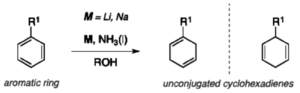
This is the reduction reaction of aromatic compounds. The reducing agent is sodium or lithium metal in liquid ammonia in presence of alcohol. Benzene ring undergoes into 1,4-reduction and form unconjugated 2,5-cyclohexadiene.
Mechanism:

The process starts with the transfer of single electron from the metal to the aromatic ring, forming an anion. This anion abstracts proton from the alcohol resulting in the neutral radical intermediate. The process repeats again resulting in the formation of cyclohexadiene.
- Wolff Kishner reduction:
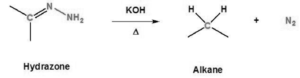
This is also a reaction in which aldehydes and ketones are converted into alkanes. In this reaction, aldehydes and ketones form their hydrazones first and these hydrazones are reduced to alkanes in presence of alkaline medium. This is the most commonly used method for converting carbonyl group into methylene group and is used to remove the carbonyl group after its synthetic purpose has been served.
Eg:

Mechanism:
Step-1: Formation of hydrazone:

Step-2: conversion of hydrazone to alkane:
Overall mechannism:

- Oppenauer-oxidation:
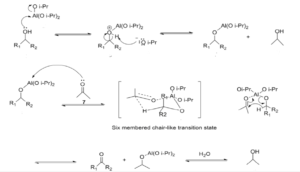
Oxidation is the opposite process or counter process of reduction. The oxidation process causes increase in the oxidation number of an atom or molecule. The substances or the catalysts that causes oxidation are called as oxidizing agents or oxidizing catalysts. In this reaction primary or secondary alcohols in presence of the catalyst aluminium triisopropoxide will get converted into ketones.

Mechanism:
- Dakin reaction:
This reaction is also one of the oxidation reactions. In this reaction, phenols are formed from aromatic aldehydes or ketones. The oxidizing agent in this reaction will be hydrogen peroxide in presence of base.
Reaction:
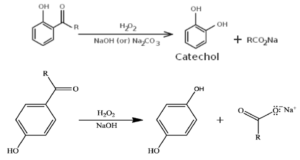
Mechanism:

- Beckmann’s rearrangement:
Rearrangement reaction is nothing but the reaction in which the atoms or groups migrate from one position to another within the molecule to form product. In Beckmann rearrangement reaction, amides are formed from oximes in acidic conditions. In this process, the oxygen atom, double bond, proton and alkyl groups of the oxime molecule rearrange themselves in the same molecule to form an amide molecule.
Reaction:

Mechanism:

- Schmidt rearrangement:
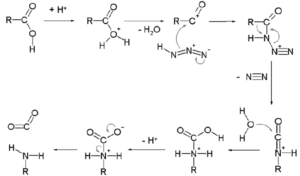
Schmidt rearrangement or Schmidt reaction occurs in between an azide and carbonyl group, resulting in the formation of an amine or an amide with loss of dinitrogen molecule.
Reaction:

Mechanism:
- Claisen-Schmidt condensation:
Claisen-Schmidt condensation occurs between an aldehyde or ketone having an α-hydrogen and an aromatic aldehyde without an α-hydrogen. Claisen-Schmidt condensation reaction is actually the reaction of an enolate ion which is versatile. These enolate ions are formed when the aldehyde or ketone with α-hydrogen is treated with a base like sodium hydroxide.
Reaction:

Mechanism:
Formation of enolate ion:

Formation of condensed product:
