
So far, we have discussed about the cyclic hydrocarbons which are made up of one cyclic ring. Cyclic hydrocarbons may also made up of more than one ring. The hydrocarbons which are made up of more than one cycle or ring are called as polycyclic hydrocarbons. We know that cyclic hydrocarbons are classified as aromatic compounds and non-aromatic compounds. These aromatic compounds may also made up more than one ring. The aromatic hydrocarbons that are made up of more than one ring are named as polynuclear hydrocarbons. These polynuclear hydrocarbons may be benzenoid compounds in which only benzene rings are present, non-benzenoid compounds in which aromatic rings other than benzene rings are present and mixed polynuclear compounds in which benzene rings are mixed with other aromatic rings. In this chapter, we will discuss about benzenoid polynuclear hydrocarbons.
Classification:
Polynuclear hydrocarbons based on the arrangement of the rings, are further classified into two categories as:
- Fused or condensed polynuclear hydrocarbons:
In this type of ring systems, the aromatic rings are fused together. i.e., the aromatic rings will be having atleast two carbon atoms in common which join the two nuclei together. Examples for this type of ring systems are naphthalene, anthracene, phenanthrene etc…

- Isolated polynuclear hydrocarbons:
In this type of ring systems, the aromatic rings are not fused together. i.e., they won’t be having any common carbon atoms to keep them together. The aromatic ring systems are joined together with atleast one single bond. In other words, we can say that in this systems, the aromatic ring systems are separated by atleast one single bond. Examples for this type of ring systems are biphenyl, diphenylmethane, triphenylmethane etc…

Properties:
Polynuclear hydrocarbons are non-polar and lipophilic in nature. These are not soluble in water. 2-ring and 3-ring polynuclear hydrocarbons are somewhat soluble in aqueous solution whereas solubility decreases as the number of rings or molecular weight of the molecule increases. 2-ring, 3-ring and 4-ring polynuclear hydrocarbons are sufficiently volatile to exist in the gaseous phase whereas molecules with greater number of rings exist as solids. Pure polynuclear hydrocarbons in solid state are colourless, white, pale yellow or pale green in colour.
Synthesis and reactions:
Naphthalene:
Naphthalene is naturally isolated from coal-tar. Chemically, naphthalene can be synthesized in three methods.
- From 4-phenylbut-1-ene:
Naphthalene is formed when 4-phenylbut-1-ene is passed through red-hot CaO.

- From 4-phenylbut-1-enoic acid:
4-phenylbut-1-enoic acid when heated with H2SO4, forms 1-naphthol. This 1-naphthol, upon distillation with zinc dust, gives naphthalene.

- Haworth synthesis:
In this method, benzene and succinic acid anhydride react with each other in presence of aluminium trichloride and form a keto acid, which in presence of zinc-mercury or hydrochloric acid undergo reduction resulting in the formation of an acid. This so formed acid undergoes ring closure reaction on heating with sulfuric acid and forms a tetralone. This tetralone again undergoes reduction in presence of zinc-mercury or hydrochloric acid and forms tetrahydronaphthalene which forms naphthalene by undergoing dehydrogenation in presence of palladised charcoal which is aromatization reaction. This synthetic process involves four steps.
- Friedel craft’s acylation
- Clemensen reduction
- Ring closure
- Aromatization

Reactions of naphthalene:
Naphthalene basically undergoes three types of reactions.
- Addition reactions: Which are otherwise reduction reactions.
In presence of sodium and ethanol, naphthalene undergoes reduction and forms 1,4-dihydronaphthalene which is also called as 1,4-dialin.
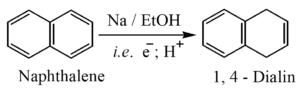
In presence of sodium and isopentanol, naphthalene undergoes reduction and forms tetralin which is also called as 1,2,3,4-tetrahydronaphthalene.

Tetralin upon heating in air, forms tetralin peroxide which on treatment with dilute sodium hydroxide, gives α-tetralone.

Catalytic reduction of naphthalene forms tetralin which further will get converted to decalin.

- Substitution reactions:
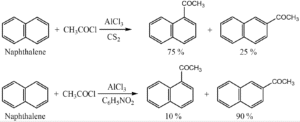
Naphthalene usually favours substitution on 1st position. However, there are two exceptions.
- Sulphonation at high temperature
- In the Friedel-Craft’s reaction
Nitration:
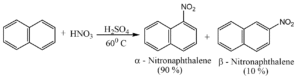
Bromination:

Benzoylation:

The reason for this favourable formation of 1-sunstituted product or α-substituted product can be well explained by considering the stability of intermediate carbocations formed during the attack of the substituent on 1st position and attack of the substituent on 2nd position. This can be well understood by the following resonance structures:
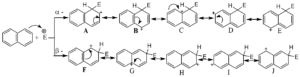
From the above resonance structures, we can observe that, when the substituent attacks on first position, two resonance structures (A & B) retained aromatic ring and when the substituent attacked on second position, only one resonance structure (F) retained aromatic ring. Hence, by this we can conclude that cation formed by the attack on first position is more stable than that formed by the attack on second position. Hence, naphthalene favours substitution reaction on first position.
Sulphonation:
Sulphonation reaction also forms 1-substituted product only. But the formed 1-substituted product is converted to 2-substituted product under high pressure. However, this 2-substituted product is unstable and reversible product. That again will get converted to 1-substituted product.

In this reaction, the formed β-isomer is thermally or thermodynamically controlled whereas α-isomer is kinetically controlled.
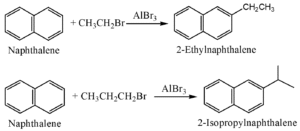
Friedel-Craft’s reaction:
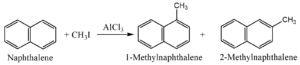
This happens in mild reaction conditions like low temperature in presence of a Lewis acid like aluminium trichloride. If mild reaction conditions are not maintained, under vigorous reaction conditions, attack of Lewis acid on naphthalene causes opening of either of the rings. Hence, mild reaction conditions are maintained. A few reactons are listed below.

- Oxidation reactions:
Oxidation of naphthalene in dry air in presence of V2O5 or with H2SO4 and HgSO4 yields phthalic anhydride.

With acidic permanganate, naphthalene undergoes oxidation and forms phthalic acid.

Oxidation with alkaline permanganate: Naphthalene yields phthalanoic acid.

Ozonolysis of naphthalene yields phthalaldehyde

Synthesis of naphthalene derivatives:
Naphthol, naphthol amines, naphthoic acids, naphthoquinones are the main naphthol derivatives.
Synthesis of naphthol:
Naphthol is synthesised industrially by mixing naphthalene sulphonic acid with sodium hydroxide.

Naphthol is also synthesized by hydrolysis of 1-naphthylamine with sulfuric acid at 180°C.

Reactions of naphthol:
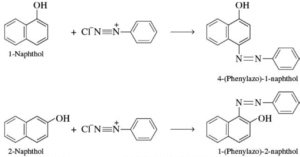
Naphthol reacts with benzene diazonium salts and form azo dyes. 1-naphthol undergoes coupling reaction with benzene diazonium salts at C-4 whereas 2-naphthol undergoes at C-1.
1-naphthol and 2-naphthol react with ferric chloride and gives different colours. 1-naphthol gives violet colour whereas 2-naphthol gives green colour. This test is used for qualitative detection of both the isomers.
Synthesis of naphthol amine:
Bucherer reaction: This is the simple method for preparation of naphthol amine. In this reaction, an isomer of naphthol (1-naphthol or 2-naphthol) is heated with aqueous solution of ammonium hydrogen sulphite and ammonia, which results in the formation of respective naphthol amine.
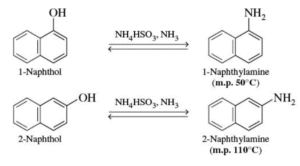
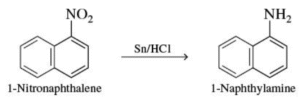
1-naphthol amine is also prepared by reduction of 1-nitronaphthalene conveniently.
Reactions of naphthyl amine:
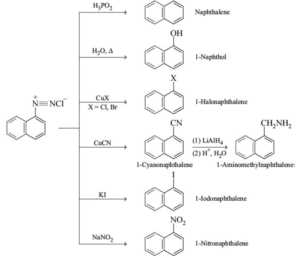
Naphthyl amine will undergo diazotization reaction and forms naphthalene-1-diazonium salt. This diazonium salt is used to prepare 1-substituted naphthalene derivatives.

On heating with sulfuric acid, naphthyl amine forms naphthionic acid, which is extensively used in dye industry.

Synthesis of naphthoic acid:
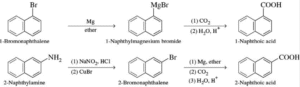
1-naphthoic acid and 2-naphthoic acid are prepared from 1-bromonaphthalene and 2-naphthylamine respectively.
2-naphthoic acid can also be prepared from 2-acetylnaphthalene by iodoform reaction.

Synthesis of naphthoquinone:
1,2-naphthoquinone is formed by oxidation of 1-amino-2-naphthol which is synthesized by coupling of 2-naphthol with benzene diazonium chloride, followed by reduction.

1,4-naphthoquinone is formed by oxidation of 4-amino-1-naphthol with chromic acid. Coupling of 1-naphthol with benzene diazonium chloride gives 4-amino-1-naphthol.

2,6-naphthoquinone is formed by oxidation of 2,6-dihydroxynaphthalene.

Naphthoquinones are good oxidising agents. 2,6-naphthoquinone is a strong oxidising agent and vitamin K is a derivative of 1,4-naphthoquinone.
Naphthalene derivatives are also synthesized by Haworth synthesis.
Synthesis of 1-methyl-7-chloronaphthalene:
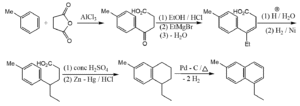
 Synthesis of 1-ethyl-6-methylnaphthalene:
Synthesis of 1-isopropyl-6-methylnaphthalene:
This synthetic process is a retro synthesis approach.
