
Introduction:
The term physicochemical is the combination of two words physical and chemical. When we talk about physical properties, these are the properties of surface or superficial of a substance/drug. That means, how the surface of the substance/drug interacts with its surrounding surfaces. When it comes to chemical properties, they reveal about the chemical behaviour of the substance/drug. The combination of both, the interaction of the surface of the compound/drug with its surroundings and its chemical behaviour is considered as physicochemical. The properties that are responsible for this physicochemical behaviour are called as physicochemical properties.
It is very important to understand the physicochemical properties of drug molecules for understanding what happens when a drug enters into the body. When a drug is administered into the body, it is not always the site of administration and the site of action will be the same. Most of the cases, especially in case of oral administrations, the site of administration and the site of action are not at all the same. In case of some infections, especially the systemic infections, we do not know where exactly the drug has to show its activity. To understand and explain all these things, we have to understand the physicochemical properties of drug molecules.
To understand the physicochemical properties of drug molecules, their importance and the need to understand them, one must understand the routes of drug administration and the transport of the drug from the site of administration to the site of action. Drugs are administered through different routes. The routes of administration are majorly classified into enteral and parenteral routes of administration. Enteral route means the oral route and parenteral route means all the other routs except the oral route. The enteral route includes oral administration, sublingual administration or buccal administration and rectal administration. The parenteral route includes intravenous, intramuscular, subcutaneous, intraatrial route. Sometimes, the routes like intranasal, inhalational, vaginal, transdermal, intraosseous routes are neither considered as enteral, nor as parenteral. These are considered as the other routes of drug administration. Whatever the route of administration maybe, the drug molecule, in order to reach the site of action, it must enter into the circulatory system. From circulatory system, the drug along with other substances like oxygen, nutrients, minerals and so many other substances will get distributed all over the body.
Hence, the drug molecule, for entering into circulatory system from the site of administration, it has to cross so many membrane barriers like cell membranes, vascular membranes etc. Here comes the concept of physicochemical properties of drugs. Perorally given drugs will be absorbed across the intestinal mucosa and for this, they must pass through various layers of absorption. Drugs that are administered through buccal, sublingual, rectal, vaginal, pulmonary or nasal are absorbed through mucosa and also has to pass through various layers of absorption. Before entering into the circulation, the drugs must also have to interact with a melange of biopolymers, paracellular and intercellular fluids, proteins and lipids. The drugs or substances administered or exposed transdermally, have to partition into and transport through cutaneous layers such as stratum corneum, stratum basale and upper epidermis. The drugs or chemical substances which do not have the requisite physicochemical properties which give access to the drug or chemical substance to the active-site, will be having only minimal biological activity or sometimes no biological activity also. Hene, the drug or the chemical substance, to show the optimum biological activity, it must have the requisite physicochemical properties.
There are so many mechanisms that convey drugs or chemical substances across the biological barriers including passive diffusion, active transport/efflux (by means of P-glycoprotein), carrier mediated transport and receptor and absorption mediated transcytosis. All the biological barriers are under physiological control and we should note that their transport characteristics are effected/influenced by the presence of other substances and also by their physicochemical properties. The drug molecules will be having a spatial arrangement which defines their physical properties which also determine the absorption and transport of the drug molecule and at the same time, they also have some chemical composition which gives chemical or biological effect on receptors. Hence, various physicochemical properties which will affect/influence the membrane permeation are discussed in this chapter. Among many properties of drug molecule that influence the absorption, transportation/distribution and biological action, we will discuss molecular weight, solubility, partition coefficient, ionization, hydrogen bonding, protein bonding, chelation, Bioisosterism, optical isomerism and geometrical isomerism in this chapter.
- Molecular weight and size:
One of the mechanisms through which drug molecules enter into circulatory system is diffusion which is directly affected by molecular weight and size of the drug molecules. If the weight of the molecule is more, then the molecule may not be able to move and may be sedimented at the site of administration or in the gastro intestinal tract or somewhere in the body without getting absorbed. If the size of the molecule is more, then the drug molecule may not be able to penetrate through the pores that are present in the membranes. In both the cases, the drug molecule will not be able to cross the membrane barriers which further leads to accumulation of the drug that may result in obstructions and/or adverse reactions in the body. In these cases, the drug molecule may not be able to reach the site of activity where it is supposed to bind to the receptors to perform its activity. Hence, the intended activity may not be achieved when the drug molecule is having higher molecular weight and size.
- Solubility:
Solubility can be defined as the amount of solute dissolved/distributed in the solvent in equilibrium at a given temperature. This parameter also influences the penetration and transport of the drug molecule. The drug molecule, for entering into circulatory system, it may have to penetrate through many biological or membrane barriers which are highly lipophilic in nature. Hence, the drug molecule should be lipophilic in nature to get penetrated through the biological/membrane barriers. The drug molecule, in order to be distributed or be transported to the target sire or the site of activity, it should be hydrophilic in nature as the transport medium is hydrophilic in nature. Hence, the conclusion is, the drug molecule should be having both hydrophilic and lipophilic characteristics in it. If the drug molecule is having more lipophilic character, then it may be struck within the membranes and may not able to enter into the circulatory system. On the other hand, if the drug molecule is more hydrophilic in nature, then it may not be able to cross/penetrate the biological/membrane barriers. In both the cases, the drug molecule may not be able to reach the target site or the site of activity which may result in not achieving the intended activity. Hence, the drug molecule should be having enough/sufficient/required amount of lipophilic and hydrophilic characteristics.
Solubility is influenced by pH of the solute, temperature and pressure. Solubility measurement is also used in the preparation of liquid dosage forms of the drugs. The interaction of the drug with its surroundings is possible only in liquid phase. Hence, solubility is one of the important physicochemical properties of the drug, that will influence its biological activity.
- Partition coefficient:
This is used to measure the distribution of drug between two immiscible phases. In the living system, we observe aqueous and lipid phases. The distribution of the drug between these two phases is measured by partition coefficient. Partition coefficient is the ratio between the concentration of a compound in lipid medium and aqueous medium. This is indicated by ‘P’.

Partition coefficient is used to measure distribution of the drug in the body. Partition coefficient also reveals whether the drug is hydrophilic or lipophilic in nature. If the value of partition coefficient (P) is high, then the drug will be more lipophilic in nature whereas highly hydrophilic drugs have low partition coefficient (P) value.
- Ionization:
Ionization/state of ionization is also one of the important physicochemical properties of the drug molecule which influences its biological activity by enabling/disabling the molecule to be absorbed and to be bound to the receptor at the target site/site of action. Degree of ionisation/Ionisation/ionisation state of a permeant is a function of its pKa and pH values at the membrane surface. Drug molecules are mostly weak acids or bases. Weak acids and bases lipid solubility is appreciable only in unionized state/form. Hence, the drug molecule to be absorbed or to pass through the biological/membrane barriers, should be in unionized form. Whereas, the same drug molecule in order to bind to the receptors at the target site/active site/site of activity, it should be in ionized form as the molecules form bonds with other molecules in ionised state only. When the pH of the drug molecule at which it is unionised, at that pH, the mucosal absorption is maximum. Hence, the drug molecule should be unionised to be absorbed and it should be ionised to get bound to the target receptors. The drug molecules exist in un-ionised or ionised form based on the pH of the vehicle. Along with drug molecule’s ionization constant (a constant which depends on the equilibrium between molecules and ions which are un-ionised in a liquid), pKa determines the actual concentrations of ionised and un-ionised molecules in which un-ionised forms are believed to pass through the intracellular route (through stratum corneum) whereas the ionised molecules are believed to pass through the intercellular spaces. The importance of ionisation or degree of dissociation as a factor of determining the permeation through the biological barriers is well proven.
The percentage of drug existing in ionized and/or in un ionized form can be calculated by using Handerson-Hasselbalch equation. For weak acids:
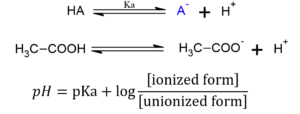
For weak bases:

Note:
In case of weak acids: pH > pKa; [A¯] > [HA] => (ionized > unionized)
In case of weak bases: pH > pKa; [HA] > [A¯] => (unionized > ionized)
If pH = pKa; [HA] = [A¯] => (unionized = ionized)
- Hydrogen bonding:
Hydrogen bonding is one of the specific examples for dipole-dipole bond, which is an important and stronger form of chemical bonding. Hydrogen bonding can be done between two atoms with different electronegativities. Hydrogen bond occurs between an electro positive and an electro negative atom. These atoms may be present in the same molecule (called as intramolecular hydrogen bonding, examples are acetyl acetone, salicylaldehyde, ethyl acetoacetate, ortho nitro phenol in which hydrogen bonding occurs between oxygen and hydrogen present in the same molecule, ortho chlorophenol in which hydrogen bonding occurs between chlorine and hydrogen present in the same molecule, etc.) or may occur between two different molecules (called as intermolecular hydrogen bonding, examples are water molecule in which hydrogen bond will occur between oxygen of one water molecule and hydrogen of another water molecule, ammonia in which the bond will be between nitrogen of one ammonia molecule and hydrogen of another ammonia molecule, hydrogen bond between amine and water, thiol and water etc.).
Several studies have recognised hydrogen bonding as one of the determinants of drug permeation across absorbing membranes. When the permeability coefficients of solutes through stratum corneum have been correlated with the presence of hydrogen bonding groups in the solute/drug molecule, it has been observed that even though the main determinant of solute’s/drug’s partition between stratum corneum and the aqueous solution is its lipophilicity, the principal influencer of diffusion of the solute/drug across stratum corneum is hydrogen bonding. When the solute/drug molecule is mono- or di- substituted with hydrogen bonding groups, the most pronounced effect has been observed on the magnitude of the diffusion coefficient.
Hydrogen bonding has also been proved to govern water solubility, drug-receptor interactions, melting point, boiling point, spectroscopic properties, viscosity, the strength of acid and biological products and surface tension which are critical in analysing physicochemical properties.
- Protein binding:
The drug molecules after entering into the body, while absorbing and even after entering into circulatory system, in circulatory system also, it has to face and may interact with many macromolecules which include adipose tissue, proteins, nucleic acids etc. The process in which drug molecule forms a complex with protein is called as protein binding. Protein binding also influences the absorption and distribution of the drug molecules. Drug molecules, when administered into the body, have to cross many membrane barriers where it may happen to bind to extravascular tissue proteins. This binding results in the formation of chelates or complexes of drug with protein, that ultimately prevents the drug molecule from being absorbed into the circulatory system or to diffuse or cross through the biological or membrane barriers into the circulatory system due making it to accumulate mainly due to heavy weight of the chelate/complex. After entering into the circulatory system also, the drug may interact with blood components like plasma proteins (albumins, glycoproteins, lipoproteins, globulins), serum albumin, blood cells (RBC, carbonic anhydrase, cell membrane) which affect the shelf life and bioavailability of the drug molecule. This also influence the binding of the drug molecule to the target receptor. Hence, protein binding nature of the drug may reduce the intended biological activity of the drug.
Protein binding of drugs may be of reversible or irreversible. Irreversible bonds include the strong bonds like covalent bonds whereas the irreversible bonds include the weak bonds like hydrogen bonds, hydrophobic bonds, ionic bonds and van der Waals forces.
- Surface activity:
Surface activity is one of the physicochemical properties of the drug molecule which influences the rate of absorption. Surface activity of a compound can be defined as the property which allows that compound to spread on a particular surface. Surface activity and surface tension are inversely proportional to each other. High surface activity results in less surface tension. Surface tension increases with the presence of surfactants. Surfactants enable the drug molecule to interact/bind with the surface of the substances they face in their way to their target site. Hence, the drug molecule may not be able to reach the target site as they may bound to other molecules they face in between. Hence, in order to increase the absorption of drug molecules, the concentration/the amount of the surfactants should be less. Surface activity is dependent on chemical structure of the surfactant, effect on biological membrane, concentration of surfactant and micelle formation of the surfactant.
- Chelation:
Chelation is the property of formation of complexes with ions. The drug molecule has to cross through the lipid membranes to reach the target site and exhibit the intended activity. But when the molecule forms complexes, it will not be able to cross through the lipid membrane which in turn fails the drug molecule from exhibiting its intended biological activity or pharmacological activity as complexation or chelation results in reduced absorption rate which slows diffusion process down.
We can consider tetracyclines as an example for this case. Tetracyclines form complexes with calcium ions. Hence, tetracyclines are not to be administered with milk or after the meal as this complexation process reduces diffusion rate of tetracyclines.

- Redox potential:
Redox potential which is also called as oxidation-reduction potential, defines the capability of a compound to lose or gain the electrons. Any molecule, to participate in a reaction or to form a bond with other molecule, it either has to accept an electron or to lose an electron. The drug molecule also, to exhibit its pharmacological activity, it has to bind to the target receptor. Redox potential is the quantitative expression and is considered as one of the most important physicochemical properties which determines the action of the drug.
- Stereochemistry:
This talks about the bulkiness, size and the shape of the molecule. i.e., this property of drug deals with the spatial arrangement of atoms and groups of that drug. The interaction of drug molecule with an enzyme or receptor is dependent on its stereochemistry. Bulkiness of the drug molecule may result in the shielding or hinderance and may inhibit the ideal interaction of the drug molecule with its receptor or enzyme. Size and shape of the drug molecule influence its physicochemical activity of the drug molecule. As the receptor or enzyme also a chemical substance, it also has spatial arrangement of its atoms or groups in it. Hence, the protein or enzyme also has particular size and shape. Drug molecule that fits in that size and shape only can show optimum activity as such a molecule can have an ideal interaction with the receptor or enzyme. In this case, when one enantiomer is active biologically, the other isomer of the same compound may not be active biologically or may have some different activity. We can consider methyl dopa and glucose molecules as examples for this. In case of methyl dopa, S-isomer is a hypersensitive whereas its R-isomer is inactive.

- Bioisosterism:
Bioisosters are the compounds or the groups that are having similar chemical and physical properties and near equal molecular shapes, volumes and approximately the same distribution of electrons and produce broadly similar biological effects. Bioisosters influence solubility, hydrophobicity, conformation, size, H-bond formation capacity, reactivity, pKa, stability, mesomeric and inductive effects of a molecule.
Bioisosteric replacement results in increased stability, greater selectivity, simplified synthesis, improved pharmacokinetics (i.e. solubility-hydrophobicity), less side effects and decreased toxicity. Bioisosters are of two types: a) classical bioisosters and b) non classical bioisosters. Classical bioisosters will be having similar shape and electronic configuration of atoms, groups or molecules that the replace. Univalent atoms and groups like Cl, Br, I, CH3, NH2, OH, SH etc., bivalent atoms and groups like R-O-R, T-NH-R, R-CH2-R, CONHR, COOR, COSR etc., trivalent atoms and groups like -BH=, -N=, -P=, -AS= etc., tetravalent ions and groups like =C=, =N=, =P= etc. and ring equivalents like -CH=CH-, -S-, -O-, -NH-, -CH2-, benzene, pyrrole, thiophene etc. are the examples for classical bioisosters. We can observe carbutamide and tolbutamide in which NH2 group of carbutamide has been replaced with the classical bioisoster CH3.

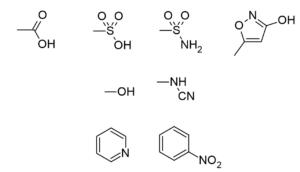
Non classical bioisosters unlike classical bioisosters, are not similar in steric and electronic parameters but are the functional groups with different valence electron configuration. Examples are:
- Optical isomerism:
This particular property talks about enantiomerism of compounds/drug molecules. Whenever a compound is synthesized, that compound by default form as a racemic mixture (mixture of both the enantiomers in equal amounts). But only one enantiomer is active and the other will be inactive or one enantiomer will give one type of activity while the other may have some other activity. This may happen due to difference in potency of the enantiomer, receptor fit, transport and metabolism. We can discuss about glucose and phenol as examples. In case of glucose, dextro form of glucose is biologically active while its levo form is inactive. When it comes to phenol, dextro phenol is only an antitussive agent whereas levo phenol along with antitussive property, also have narcotic and also analgesic properties.

- Geometrical isomerism:
Geometrical isomerism deals with the geometrical/positional arrangement of atoms or groups in a molecule. Both the geometrical isomers say cis- and trans- isomers will be having different arrangement of their atoms or groups and hence different shapes. Hence, geometrical isomerism also influences the biological activity of the drug molecule.