
Meso compounds:
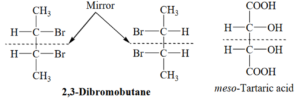
Meso compounds are also having two or more stereo centres like diastereomers. Along with this, meso compounds are also having plane of symmetry, which is characteristic property to meso compounds. That means, meso compound can be divided into two equal halves, which are mirror images and superimposable on each other. Hence, meso compounds are defined as the compounds with two or more stereo centres and have a plane of symmetry through which the compound can be divided into two equal halves which are super imposable mirror images.
Properties of meso compounds:
- Meso compounds are symmetric compounds and they have an internal mirror plane that the right and left sides of the plane are mirror images to each other.
- Meso compounds as discussed above, will have at least two stereo centres or chiral centres and this is an important characteristic of meso compounds.
- Meso compounds are superimposable on their own mirror images. Such compounds are called as achiral compounds. Hence, meso compounds are achiral.
In meso compounds, one half of the molecule will rotate the plane of polarized light in one direction and the other half in opposite direction, as a result, the net rotation of the molecule will be zero which makes the meso compounds optically inactive.
Symmetry:
Symmetry is one of the characteristic properties exhibited by the geometrical objects divided into two equal halves by the axis that has been crossed the shape through the middle of the object. Such an object is said to be symmetric if both the halves appear similar to each other. Otherwise, the object is called as asymmetric.
Symmetry is a property of a geometrical object that shows the two halves of the object the same when the object is mirrored or reflected along an axis that pass through the shape through its middle, dividing into two equal halves.
Simply, symmetry can be defined as the quality of being made up of exactly similar parts facing each other or around an axis.
Properties of symmetrical molecules:
- Symmetrical molecules form superimposable mirror images.
- Symmetrical molecules do not deflect the plane of polarized light.
- Hence, symmetrical molecules are optically inactive.
- Symmetrical molecules may possess any of the following elements of symmetry:
Elements of Symmetry
- Plane of symmetry:
Plane of symmetry is that element of symmetry within the molecule through which, when the molecule is divided into two equal halves, each half of the molecule will be the mirror image of the other.
Any molecule to possess the plane of symmetry, it should have the same type and number of atoms or groups on both the sides of the molecule i.e., one half of the molecule should form the mirror image on the other side. In other words, plane of symmetry means, the plane that bisects a molecule/object into two equal halves.
- Center of symmetry:
This element of symmetry is a center point of the molecule through which when a line is passed from any group of the molecule and that line is extended to an equal distance beyond the center point, meets an identical group.
A center of symmetry is usually possible in evenly numbered rings only.
- Axis of symmetry:
This element of symmetry also involves the center point of the molecule. When an axis is passing through the center point of the molecule and the molecule is rotated by a certain angle through that axis, results inn similar arrangement to that of before rotation.
Asymmetry:
If the molecule is not symmetric by means of any of the above elements of symmetry, then that molecule is said to be asymmetric molecule or in other words, if the molecule is made up of different parts facing each other or around an axis, then it can be called as asymmetric molecule. Asymmetric molecules are optically active as they can deflect the plane of the plane polarized light.
- Asymmetric synthesis:
According to Morrision and Mosher, asymmetric synthesis is a reaction in which a chiral unit is formed from an achiral unit in an ensemble of substrate molecules in such a way that unequal isomers are produced.
According to IUPAC, asymmetric synthesis is defined as a chemical reaction or reaction sequence in which one or more new elements of chirality are formed in a substrate molecule which produce the stereoisomeric (enantiomeric/diastereomeric) products in unequal amounts.
Simply, asymmetric synthesis can also be called as chiral synthesis or enantioselective synthesis as in this synthesis, the method used favours the formation of a specific enantiomer or diastereomer. If the synthesis of asymmetric carbon/chiral carbon is done by conventional laboratory methods from an achiral compound, then the produced compound will be a racemic mixture. Whereas only one of optically active isomer will preferentially form over the other if such a synthesis carried out under chiral influence.
Racemic reaction:

Asymmetric reaction:

Chiral environment is the mandatory condition for asymmetric synthesis and based on the relationship between the products that are formed in asymmetric synthesis, reaction may be enantioselective or diastereoselective.

Examples of natural products constructed by the use of asymmetric synthesis:

For successful asymmetric synthesis, we need either prochirality or asymmetric induction conditions.
- Prochirality:
This is a condition in which the carbon atom is already tetrahedral i.e., bonded to four groups and if two of them are similar and one of that group is substituted or replaced with a different group that results in the production of a chiral carbon atom and the molecule will be enantiotopic or diastereotopic based on the type of product formed.
Eg: Enantiotopic:
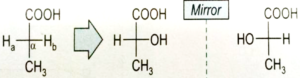
Diastereotopic:

- Asymmetric induction:
This is the condition in which the presence of an element of chirality plays a crucial role. Property of chirality/asymmetry is induced by this chiral reagent. Apart from the chiral reagent, the property may also be induced by the catalyst used or the solvent used or by circularly polarized light.
- Asymmetric synthesis is very important because:
In the earlier days, optically pure compounds were used to be obtained by isolation from natural products or by resolution of racemic mixtures or by laboratory controlled enzymatic reactions. But when these methods are used, the produced or obtained optically active compound used to be very low. We know very well that all naturally occurring or biologically occurring molecules are chiral. Also, we know that different enantiomers or diastereomers of a compound have different biological activity. For example, (+)-glucse is biologically active whereas (-)-glucose is not and (+) and (-)-thalidomides have different biological activities. Hence, synthesis of optically pure substances is very important and for this, asymmetric synthesis is used.
- Major approaches inn asymmetric synthesis:
A chiral molecule can be synthesized (asymmetric synthesis) either in partial asymmetric synthesis method or in absolute asymmetric synthesis method.
- Partial asymmetric synthesis:cip
As the name itself indicates, this method is partially asymmetric synthesis. That means, any of the reaction conditions provided may be chiral or optically active. Most commonly, in this method, we will use an optically active reagent. Hence, this method is defined as the method in which a new chiral center is synthesized from an achiral center by using an optically active reagent. Partial asymmetric synthesis involves different methods.
- First generation method (Use of chiral substrate/chiral pool synthesis):This is the simplest and oldest method of asymmetric synthesis. In this method, readymade chiral centers or readily available chiral starting materials are used. In this method, the chiral starting material is manipulated to obtain the desired target molecule, through successive reactions and hence this is the more economical way of making enantiopure form of compounds. This method is attractive especially for target molecules sugar or amino acid.

We can also consider the formation of L-Dopa from L-tyrosine.

In this conversion, we can see that L-tyrosine is a chiral molecule and it is naturally occurring, and also this conversion is not affecting the existing stereocenter1. Hence, we can say that in this method, we are using naturally occurring chiral molecules and this method is hence also called as chiral pool synthesis method.
- Second generation method (Use of chiral auxiliary):Auxiliary is a compound that couples to starting material resulting in the formation of new compound that undergoes the desired reaction. In this method, the substrate or starting material, which is prochiral will give a chiral intermediate by attaching to a chiral auxiliary. During the formation of this intermediate, the auxiliary dictates the preferred stereochemistry and when the final product is formed, the auxiliary will be removed and be reused. For removing auxiliary such reaction conditions are maintained in which racemization of the product will not happen.
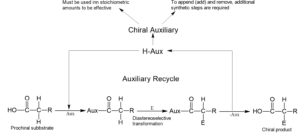 Asymmetric alkylation of cyclohexanone using SAMP [(S)-1-amino-2-methoxymethylpyrrolidine] is an example for this method.

- Third generation method (Use of chiral reagent):This method is enantiospecific. In this method a chiral reagent is used and in the reaction process, this chiral reagent will convert into achiral. This is the process in which an achiral substrate is converted into chiral product that too selectively into one of the enantiomers. Hence, this is enantiospecific. The reagent used in this reaction process or synthetic method is “self-immolative” as it itself get achiral in the reaction process.
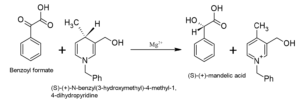
Use of chiral catalyst:
Chiral coordination complexes are used as catalysts in this method. This is the most commonly used method and use of effective optically pure catalysts give much more promising results. This is because, the reagent is needed in stoichiometric amounts, but if we use catalyst instead, very small amounts of catalysts may be sufficient and will be broader range of transformations than any other methods. However, in this method also, generation of chiral-at-metal complexes is possible using simpler achiral ligands.
 Absolute asymmetric synthesis:
In this method, optically active products have been synthesized from achiral substrate without using the reagents which are optically active. Here in this method, circularly polarized light is used for the induction of chirality.
Eg: Adding bromine to 2,4,6-trinitrostilbene results in a dextrorotatory product.

Significance of asymmetric synthesis:
- Asymmetric synthesis has become a key process in modern chemistry.
- Asymmetric synthesis is particularly important in the field of pharmaceuticals because, different enantiomers or diastereomers of a molecule are having different biological activities.