
Amines are considered as the derivatives of ammonia. In the earlier sections of this textbook, we have discussed about open chain amines. In this chapter, we will discuss about aromatic amines. In aliphatic amines, amine group is attached to an aliphatic carbon chain whereas, in aromatic amines, the amine group is attached to an aromatic ring. The simplest aromatic amine is aniline. As in case of aliphatic amines, aromatic amines also are classified based on the number of hydrogen atoms replaced by alkyl/aryl groups as primary (1°), secondary (2°) and tertiary (3°) amines.

Nomenclature:
Aromatic amines are named as amine derivatives of aromatic ring. The simplest aromatic amine, aniline is having an amine group attached to benzene. Hence, it can also be called as benzamine or amino benzene. The other aromatic amines are also named similarly. The prefix will be the aromatic ring and the suffix will be amine. Position of amine group is designated numerically.
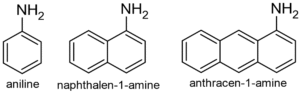
Properties:
- Physical properties:
- Aromatic amines are present as solids and liquids.
- Solids are having low-melting points and liquids are having high boiling points.
- Aromatic amines are having special odour and high toxicity.
- Aniline if enters into body by any means, can easily be poisoned and β-naphthylamine and benzidine cause malignant tumours.
- Chemical properties:
Aromatic amines behave in a similar way to aliphatic amines. They undergo all the reactions that aliphatic amines undergo. Along with that, aromatic amines show difference from aliphatic amines with respect of-
- Reaction with nitrous acid:
Diazonium salts are formed with primary amines.

Nitrosoamines are formed with secondary amines and tertiary amines.


- Rearrangement reactions: Intermolecular migration occurs at 300-400°C in strong acidic medium with N,N-dialkylamines.

- Oxidation
Aromatic amines with hydrogen on ‘N’ undergo oxidation very easily and the products differ with reaction conditions and different types of oxidants.
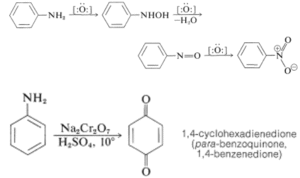
- Electrophilic aromatic substitution on aromatic ring.
Aromatic amines are highly favoured for electrophilic substitution reactions on aromatic ring. The amine group directs the second substituent towards ortho or para positions.

Basicity of aromatic amines:
Aromatic amines are less basic when compared with ammonia and aliphatic amines. The reason for this is that the lone pair of electrons that are present on nitrogen are participating in conjugation (delocalization). Hence, these electrons are not readily available for bond formation or to react with any other reagent. Hence, aromatic amines cannot be protonated that easily compared with ammonia and aliphatic amines. Hence, aromatic amies are less basic compared with ammonia and aliphatic amines.
Also, if we draw the resonance structures for both aniline, which is an aromatic amine and for anilinium ion, which is protonated aniline, aniline is having five resonance structures whereas anilinium ion is having only two. We know that more resonance structures mean more stability. Hence, aniline is more stable than anilinium ion. That means, aniline won’t favour protonation and hence is less basic. This is similar with other aromatic amines also. Aromatic amines are les basic than ammonia and aliphatic amines.

Effect of substituents on basicity:
In case of substituted aromatic amines, it is observed that electron donating groups or activating groups like -OCH3, -CH3 increase the basic nature of aromatic amines and the deactivating groups or electron withdrawing groups like -NO2, -SO3H, halogens, -COOH decrease the basic nature of aromatic amines by a combination of resonance and inductive effect.
Besides this concept, it is also observed that, any substituent that is present ortho to the amine, no matter whether it is electron donating or electron accepting/withdrawing in nature, that will decrease the basicity of the amine. This effect is called as ortho effect.
Synthesis of diazonium salts:
Aromatic diazonium salts are prepared by treating primary aromatic amines with HNO2 or NaNO2 in presence of HCl at 0°C.
General reaction:


Synthetic uses of Diazonium salts:
- Azo compounds because of their highly coloured nature, they are mainly used as dyes in dying industry.
- Diazonium salts are used to prepare indicators like methyl orange which is used as an acid base indicator as it gives different colours in its acid and salt forms.
- Diazonium salts are used to prepare artist’s paints-clays from yellow to red range.
- Diazonium salts are also used in dye industries to prepare dyes like Direct brown 138 and Sunset yellow FCF etc.
- Diazonium salts are also used in textile and food industries as dyes.
- Diazonium salts are also used to synthesize many aromatic compounds as the diazonium group can easily be replaced by other groups like -OH, -F, -I, -Cl, -Br, -SH, -CN, -NO2, -H and -Ar.